

When the AC hums but the house stays hot
July in Lake County is not dry heat. It’s 91 degrees with air you could wring out, and it stays sticky well after dark. So when the central air stops keeping up, you notice fast. The upstairs bedrooms go first. Then the thermostat starts creeping: 76, 78, 81. The outdoor unit may still be humming away, which almost makes it worse. It sounds like it’s working.
Good news first: most AC failures are small. The part that fails more than any other on a central air system costs less than a nice dinner out. We’ll get to that. But first, how we run an AC repair call, because the order is what keeps the bill honest.
How an AC repair visit goes
- You call and a person answers. Evenings and weekends too. We ask what the system is doing, walk you through a couple of quick checks, and give you the diagnostic fee before anyone comes out.
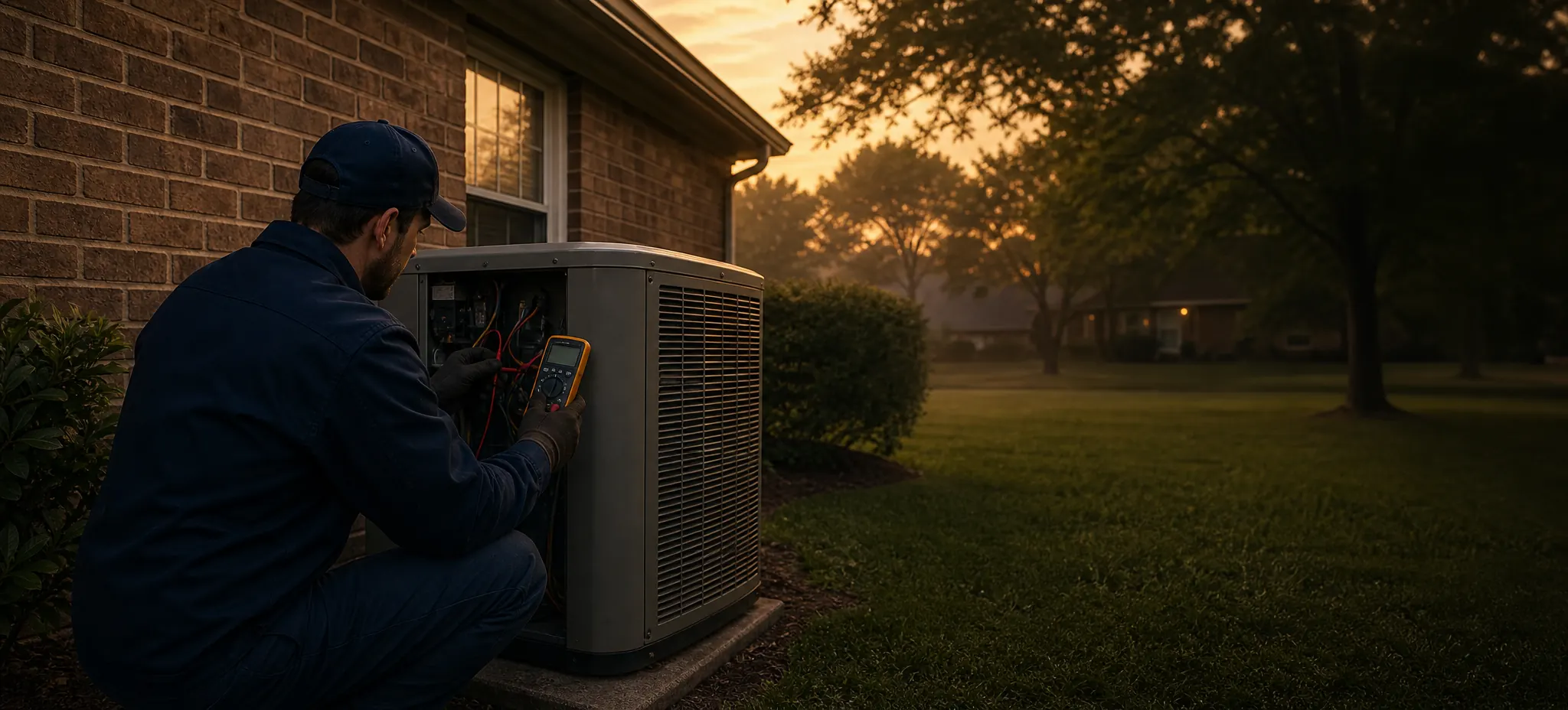
- We start outside. The tech checks the condenser: is the fan spinning, is the compressor running, is the coil clean, is the power getting there.
- Then inside. Filter, blower, evaporator coil, drain line, thermostat. Airflow problems inside cause a lot of the failures outside.
- Measure, don’t guess. Temperatures across the coil, electrical readings on the capacitor and contactor, refrigerant pressures when the symptoms call for it.
- Price on paper. The repair gets a written flat price. Nothing starts until you agree.
- Fix and confirm. We run the system and check the air coming out of the vents before we call it done.
The failures we fix most
Capacitors
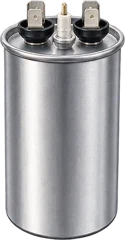
This is the one. A capacitor gives the compressor and the outdoor fan the kick they need to start. Heat is hard on them, and a long stretch of 90-degree days finishes off weak ones. The classic sign: the outdoor unit hums, the fan doesn’t spin (or spins slowly), and the air inside isn’t cold. It’s usually a quick, inexpensive repair. It is not a reason to buy a new air conditioner, whatever anyone tells you.
Contactors and electrical
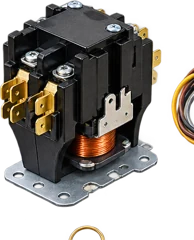
The contactor is the switch that tells the outdoor unit to run. Its contacts pit and burn over time, and ants and wasps like to build in there. A failed contactor can leave the outdoor unit dead while the indoor fan keeps blowing warm air. We also check the disconnect by the unit, the breaker, and the thermostat wiring, which can get chewed or corroded over the years.
Fan motors
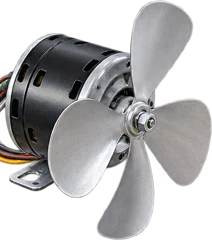
The outdoor fan pulls air through the condenser coil to get rid of the heat from your house. When the motor’s bearings wear out, it slows, overheats, and quits. If the fan isn’t turning while the compressor runs, shut the system off at the thermostat and call. Running a compressor without its fan is how a small repair turns into a big one.
Frozen coils and drain problems
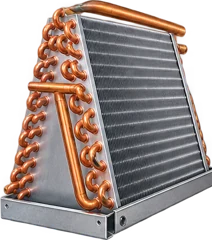
Ice on the copper line outside or on the indoor coil usually means low airflow or low refrigerant. A clogged filter is the most common reason. Turn the cooling off, run the fan alone to thaw it, and change the filter. Meanwhile, a plugged condensate line or a failed condensate pump can back water up and shut the system down, or drip onto a basement floor. Both are straightforward fixes.
A word about refrigerant
Air conditioners don’t use up refrigerant. It’s a sealed system. If yours is low, it has a leak. Adding refrigerant without finding the leak is like putting air in a tire with a nail in it: it works for a while, then you pay again. We’ll tell you if the charge is low, look for where it’s going, and give you the options on paper. Sometimes the leak is at a fitting or valve and the fix is simple. Sometimes it’s in a coil, and the numbers get bigger. Either way, you’ll see them.
Running, but not cooling
This is the complaint we hear most, and it has a list of causes you can check in order. Is the thermostat on COOL and set below room temperature? Is the filter clean? Is the outdoor unit running, fan and all? Is the outdoor coil packed with cottonwood fluff and grass clippings? Our article on why an AC runs but doesn’t cool walks through each of those. If the house feels cool but clammy, that’s a different problem, often airflow or an oversized unit, and why your house is humid with the AC on covers it.
Repair first, even on an older unit
Plenty of the central air systems we see around here are 15 or 20 years old. Some run older refrigerant that’s expensive now. That’s worth knowing, and we’ll tell you if it affects your options. But an old condenser with a bad capacitor still just needs a capacitor. Our techs aren’t paid on commission, so nobody gains by turning a $200 repair into a new system.
When a replacement truly makes sense, like a failed compressor on an old system or a coil leak that would cost more than the unit has left, you’ll see the repair price and the replacement price side by side. If you end up going that way, our AC installation page explains how we size and quote a new system.
Pick your town
Each town we serve has its own AC repair page with local notes. Start with home base, AC repair in Munster, or pick yours: Highland, Hammond, Dyer, Schererville, St. John, Griffith, Crown Point, Merrillville, Hobart, East Chicago, Whiting, Cedar Lake, Lansing, IL and Calumet City, IL. The whole map lives on our service area page.
What to try while you wait
- Set the thermostat to COOL, a few degrees below room temperature, fan on AUTO.
- Swap the filter if it’s gray or you can’t see light through it.
- Check the breaker and the outdoor disconnect switch.
- Hose off the outdoor coil gently, from the inside out if you can, with the power off.
- If you see ice, turn cooling off and run the fan only until it thaws.
- Close blinds on the sunny side and keep the oven off.
Don’t open the outdoor unit’s electrical panel. Capacitors hold a charge even with the power off, and they can hurt you. Leave that one to us.
Keeping it running next summer
A spring check on the AC catches weak capacitors, dirty coils and slow drains before the first heat wave, when everyone’s calling at once. Our seasonal tune-ups page lays out what the visit includes. For plain, non-sales guidance on keeping central air efficient, the Department of Energy’s Energy Saver site is worth a look.
Hot house? Call
Call (219) 555-0142. A real person answers, even on a Saturday night in August. We’ll tell you what the visit costs, find the part that failed, and write the repair price down before we touch it. Not urgent? Use the form below and we’ll call you back.